Apple farming has evolved rapidly over the years. Traditional orchard practices are now being replaced by more scientific and efficient management systems that help growers improve productivity, fruit quality, and resource utilization. One of the most important innovations in modern apple cultivation is fertigation.
Earlier, fertilizers were mostly applied manually in orchards. This method required more labour, consumed time, and often resulted in uneven nutrient distribution. However, with the increasing adoption of drip irrigation systems, fertigation has become one of the most effective nutrient management practices in apple orchards.
Fertigation combines irrigation and fertilization into a single efficient system, making orchard management more precise and convenient for growers.
Modern Apple Orchard Fertigation
What is Fertigation?
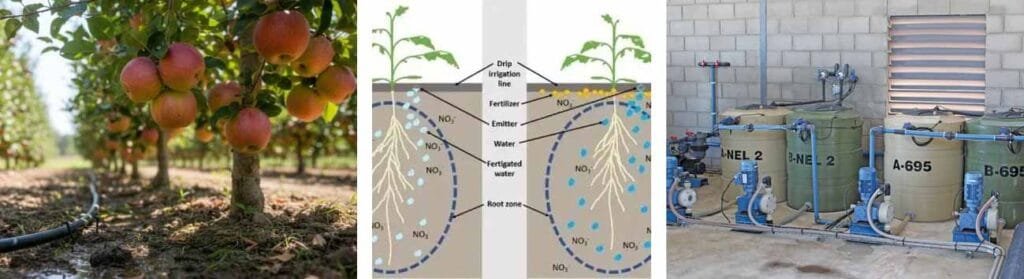
Fertigation simply means applying fertilizers through irrigation water. In this method, water-soluble fertilizers are mixed into the drip irrigation system and supplied directly near the root zone of the apple trees.
Instead of applying large amounts of fertilizer at once, fertigation allows nutrients to be supplied in smaller and controlled doses according to the crop requirement and growth stage.
This helps plants absorb nutrients more efficiently and reduces nutrient losses.
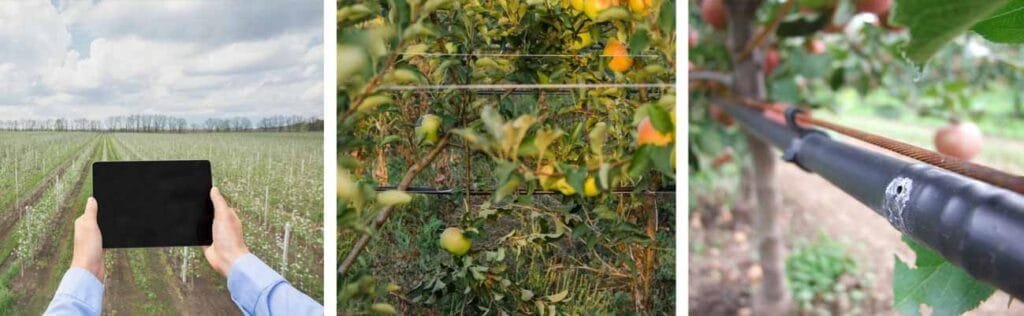
Fertigation Process in Orchards
Why Fertigation is Important in Apple Orchards
Modern apple orchards, especially high-density plantations, require precise nutrient and water management. Since more plants are grown in a smaller area, maintaining balanced growth becomes extremely important.
Fertigation helps growers manage nutrient supply more accurately and efficiently.

Major Benefits of Fertigation
- Better nutrient use efficiency
- Reduced fertilizer wastage
- Uniform nutrient distribution
- Labour saving
- Improved plant growth
- Better fruit quality
- Easy stage-wise nutrient management
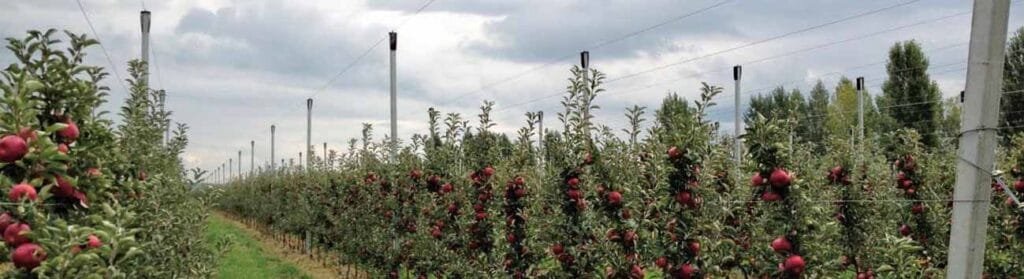
High-Density Apple Orchard Nutrition
Efficient Nutrient Delivery Through Fertigation
One of the biggest advantages of fertigation is nutrient efficiency.
In traditional fertilizer application methods, nutrients may get lost due to:
- Leaching
- Surface runoff
- Improper placement
- Excess irrigation
But in fertigation, nutrients are delivered directly to the active root zone where absorption occurs most effectively.
This improves nutrient uptake and reduces wastage.
Advantages of Efficient Nutrient Supply
- Improved root activity
- Better nutrient absorption
- Balanced plant growth
- Reduced nutrient loss
- Higher fertilizer efficiency
Root Zone Nutrient Delivery

Importance of Fertigation in High-Density Apple Orchards
High-density apple orchards need accurate nutrient management because trees compete for nutrients, water, and sunlight.
Even small nutrient imbalances can affect:
- Flowering
- Fruit setting
- Fruit colour
- Fruit size
- Yield quality
Fertigation allows growers to adjust nutrient supply according to crop growth stages.
Stage-Wise Nutrient Management
During Vegetative Growth
Nitrogen helps in shoot and leaf development.
During Flowering
Balanced nutrients improve flowering and pollination.
During Fruit Setting
Calcium and boron support fruit setting and reduce fruit drop.
During Fruit Development
Potassium improves fruit size, colour, sweetness, and firmness.
Apple Growth Stages and Nutrient Management

Labour Saving and Operational Convenience
Manual fertilizer application in orchards requires significant labour and time, especially in hilly apple-growing regions.
Fertigation simplifies this process by applying fertilizers along with irrigation.
Labour Saving Benefits
- Less manual work
- Reduced labour cost
- Faster fertilizer application
- Easy nutrient scheduling
- Improved operational efficiency
This becomes highly beneficial for commercial orchards with large plantation areas.
Fertigation Labour Saving System

Uniform Nutrient Distribution Across the Orchard
In manual fertilizer application, some trees may receive more nutrients while others receive less. This often leads to uneven growth within the orchard.
With fertigation systems, nutrients are distributed more uniformly throughout the orchard.
Benefits of Uniform Distribution
- Consistent plant growth
- Better orchard uniformity
- Balanced canopy development
- Improved fruit quality consistency
Uniform nutrition is especially important in commercial apple production systems.
Uniform Growth in Apple Orchards

Important Points for Successful Fertigation
Although fertigation provides many benefits, proper management is essential for achieving good results.
Use Only Water-Soluble Fertilizers
Fertilizers should dissolve completely in water. Undissolved particles can block drip lines and emitters.
Maintain Proper Filtration
Good filtration systems help prevent clogging and ensure smooth fertilizer flow.
Monitor Fertilizer Quantity Carefully
Excess nutrient application may cause:
- Excess vegetative growth
- Poor fruit colour
- Reduced fruit quality
- Nutrient imbalance
Apply Nutrients at the Right Time
Nutrients should be supplied according to crop stage and plant requirement.
Fertigation Management and Monitoring

Common Fertilizers Used in Apple Fertigation
Several water-soluble fertilizers are commonly used in apple orchards.
Common Fertilizers
- Calcium Nitrate
- Potassium Nitrate
- Mono Ammonium Phosphate (MAP)
- Mono Potassium Phosphate (MKP)
- Magnesium Sulphate
- Water-Soluble NPK Fertilizers
Fertilizer selection depends on:
- Soil condition
- Water quality
- Crop stage
- Leaf analysis
- Orchard requirement
Water-Soluble Fertilizers for Orchards


Challenges in Fertigation
Despite its many advantages, fertigation also requires technical understanding and proper management.
Common Challenges
- Initial installation cost
- Requirement of quality irrigation water
- Risk of emitter clogging
- Need for technical knowledge
- Regular system monitoring
However, with proper planning and guidance, these challenges can be managed successfully.
Challenges in Drip Fertigation Systems

The Future of Modern Orchard Nutrition
Fertigation represents the future of scientific orchard management. Modern apple farming is no longer only about applying fertilizers — it is about supplying the right nutrients in the right quantity at the right time.
This precision-based nutrient management approach helps growers improve productivity while using water and fertilizers more efficiently.
As high-density apple orchards continue to expand, fertigation is becoming an essential practice for sustainable and profitable apple production.
Future of Precision Apple Farming

Conclusion
Fertigation has become one of the most effective nutrient management techniques in modern apple orchards. By combining irrigation and fertilization, it improves nutrient efficiency, saves labour, reduces fertilizer wastage, and supports balanced plant growth.
For high-density apple orchards, where precision management is critical, fertigation provides growers with better control over orchard nutrition during every growth stage.
With proper planning, suitable fertilizers, and careful monitoring, fertigation can significantly improve orchard productivity, fruit quality, and long-term sustainability in modern apple farming.
Sustainable Apple Orchard Management