Chilling Hours Management in Apple: Is Artificial Ice Formation a Scientific Solution?
A Scientific Technical Report Based on Field Research by Orchard Solutions (2023–2025)
India’s apple industry is concentrated in Uttarakhand, Himachal Pradesh, and Jammu & Kashmir—regions traditionally known for long, cold winters. Over the past decade, however, climate change has significantly altered winter patterns, leading to shorter and milder cold periods.
Based on orchard surveys and field observations conducted by Orchard Solutions between 2023 and 2025, chilling hour accumulation in many traditional apple belts has declined by 12–18% on average. This reduction has directly impacted flowering uniformity, fruit set, yield consistency, and overall orchard profitability.
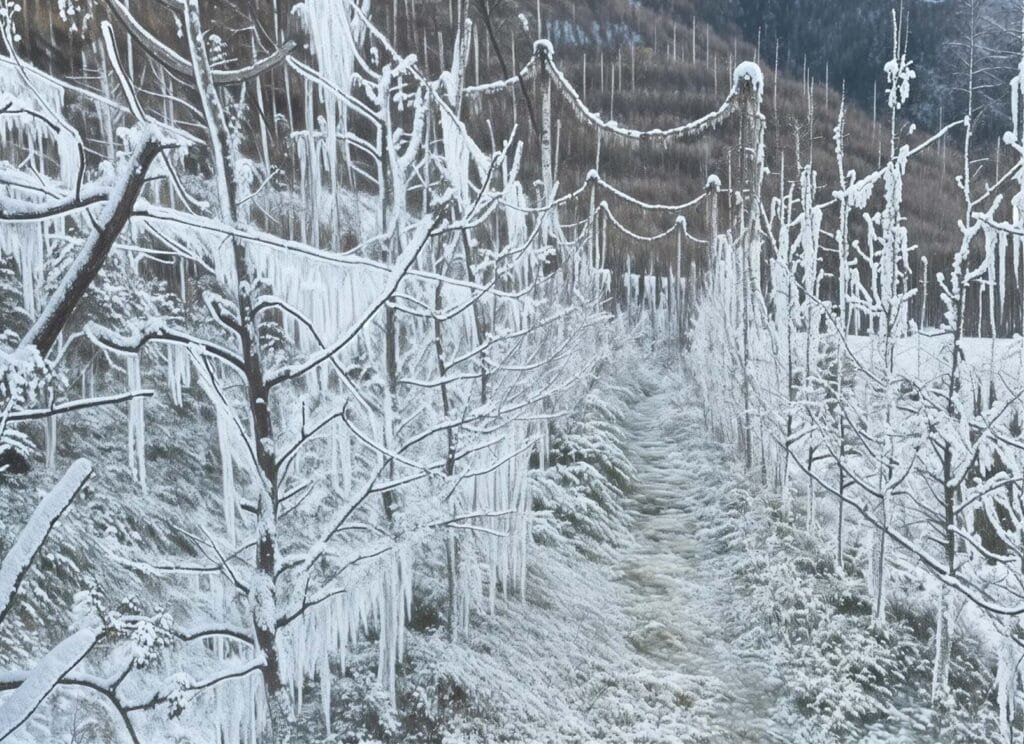
In response, some growers have begun experimenting with night-time water sprinkling to create artificial ice on apple trees, assuming it may compensate for insufficient chilling hours.
This article presents a scientific, biological, and practical evaluation of this practice.
1. Understanding Chilling Hours: The Biological & Hormonal Basis
Apple is a temperate fruit crop that undergoes winter dormancy. Dormancy is a survival mechanism that allows the tree to withstand cold stress and synchronise growth in spring.
Key hormonal changes required to break dormancy:
- Reduction in Abscisic Acid (ABA) – the hormone responsible for maintaining dormancy
- Activation of Gibberellins and Cytokinins – hormones responsible for bud break and shoot growth
These changes occur only when buds are exposed to temperatures between 0°C and 7°C for a required duration, known as chilling hours.
Critical Scientific Note
Chilling hours are calculated strictly on ambient air temperature, not on surface conditions such as frost or ice formed on branches.
2. The Concept of Artificial Ice Formation
In some apple-growing pockets, a belief has emerged that:
“If water is sprayed through micro-sprinklers at night and ice forms on the tree, chilling requirements will be fulfilled.”
To test this assumption, Orchard Solutions conducted a pilot-scale field trial during winter 2024–25 across selected orchards.
Key observations from the trial:
- ❌ No measurable increase in chilling hours was recorded
- ❌ Bud mortality increased, especially on fruiting spurs
- ❌ A higher incidence of fungal and bacterial diseases was observed
The data clearly indicated that surface ice formation does not contribute to chilling accumulation.
3. Why Artificial Ice Formation Fails: Biological Reasons
(a) Freeze Injury to Buds and Tissues
When water freezes:
- It expands inside plant cells
- Cell membranes rupture
- Bud tissues suffer irreversible damage
This leads to:
- Poor bud break
- Reduced flowering
- Partial or complete crop loss
(b) No Role in Hormonal Dormancy Break
Dormancy release is:
- A biochemical process
- Triggered by air temperature exposure over time
Ice formed on the bark or buds is purely physical and does not influence hormonal signalling inside plant tissues.
(c) Increased Disease Pressure
Prolonged moisture combined with low temperatures creates ideal conditions for diseases such as:
- Apple Scab
- Canker
- Root Rot
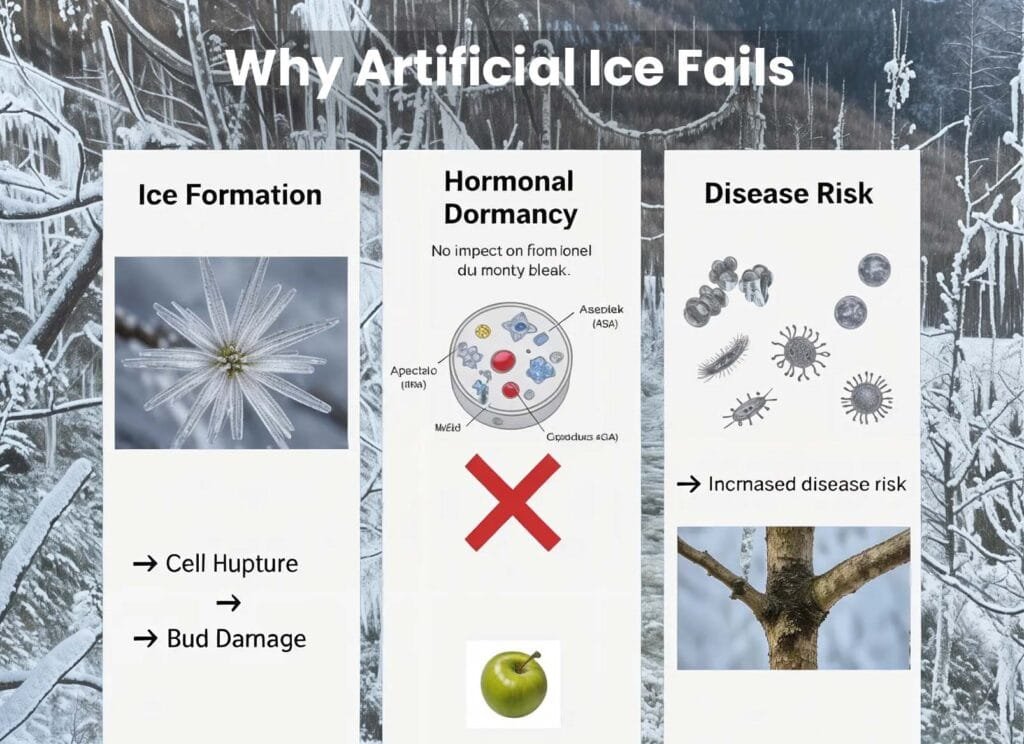
In several trial orchards, disease incidence was significantly higher where artificial ice formation was attempted.
4. International Scientific Evidence
Research from globally respected institutions supports these findings, including:
- Washington State University (USA)
- INRA (France)
- ICAR–Shimla (India)
Their unified conclusion states:
“Artificial surface ice formation is not a substitute for chilling accumulation and significantly increases the risk of freeze injury and disease.”
5. Scientifically Recommended Alternatives
Instead of risky and unproven practices, Orchard Solutions recommends the following science-backed strategies:
✔ Selection of low-chill apple varieties
✔ Use of dormancy-breaking sprays under expert guidance
✔ Adoption of M9-based High-Density Plantation (HDP) systems
✔ Microclimate management (orientation, canopy design, wind flow)
✔ Orchard establishment at climatically suitable elevations
These approaches address chilling deficiency without compromising tree health.
6. Future Strategy for Apple Growers
Considering current climate trends:
- Traditional high-chill varieties will fail in lower-altitude regions
- Low-chill cultivars will become essential
- High-Density Plantation systems will be the industry standard
- Scientific orchard planning and data-driven decisions will determine long-term success
Apple cultivation is moving from tradition-based practices to precision horticulture.
7. Conclusion
Artificial ice formation is not a solution to chilling deficiency in apples.
It does not increase chilling hours, disrupts plant physiology, and increases the risk of freeze injury and disease.
Chilling is a natural, air-temperature-driven process.
It can only be managed through scientific orchard design, varietal selection, and climate-adaptive practices.
Orchard Solutions remains committed to providing field-tested, science-backed guidance for sustainable apple production in India.