The image of a traditional Indian farmer—relying solely on monsoon rains and heirloom seeds—is rapidly being replaced by a new generation of “Agri-entrepreneurs.” In 2026, fruit farming in India has moved from a subsistence activity to a high-technology, high-margin business.
At Orchard Solutions, we are seeing savvy investors pivot from real estate and stocks into High-Density Apple Orchards. Why? Because with the right technology, an acre of land in the Indian highlands can now outperform traditional commercial investments.
1. The Market Reality: Why Fruits, Why Now?
India is the world’s second-largest producer of fruits, yet we still import a massive volume of premium apples and stone fruits from the US, Chile, and New Zealand. This represents a multi-billion rupee opportunity for local growers to provide “Import Quality” fruit grown right here in India.
- Rising Middle Class: Demand for “Super-fruits” and premium-grade apples (crunchy, high-color, uniform size) is at an all-time high.
- Shelf Life & Logistics: Improved cold-chain logistics in India mean farmers can now sell their produce in Chennai or Bangalore just as easily as in Delhi or Srinagar.
2. The Core Innovation: High-Density Plantation (HDP)
The “secret sauce” behind Orchard Solutions’ success is the shift from Standard to High-Density layouts.
Traditional vs. Modern HDP
In a traditional orchard, trees are spaced $6 \times 6$ meters apart, leading to massive, unmanageable trees that take 8 years to fruit. In our HDP model, we use M9 or M26 Dwarfing Rootstocks and a much tighter spacing.
| Feature | Traditional Orchard | Orchard Solutions HDP |
| Plants per Acre | 150 – 200 | 1,000 – 1,200 |
| First Harvest | Year 7 or 8 | Year 2 or 3 |
| Full Production | Year 12 | Year 5 |
| Fruit Quality | Variable (shaded interiors) | Uniform (maximum sun exposure) |
| Labor Cost | High (climbing tall trees) | Low (pedestrian orchards) |
3. The Math of Profitability: A Simple Breakdown
Let’s look at the financial life cycle of 1 Acre of High-Density (HDP) Apple Farming in India.
A. The “One-Time” Startup Cost
The total setup cost is approximately ₹20.45 Lakhs for 1 acre. Here is where that money goes, broken down per tree:
- M9 Rootstock Plant): ₹700 – ₹850
- Trellis, Wire, Support: ₹700 – ₹800
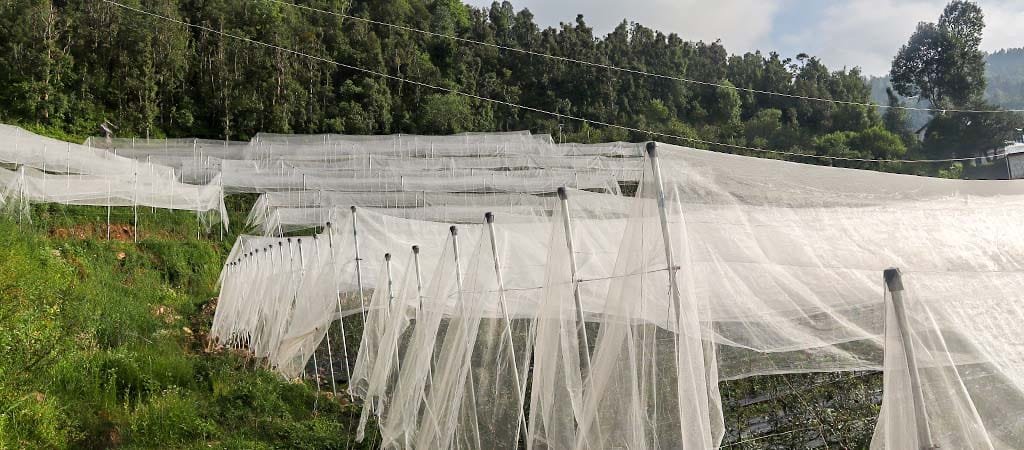
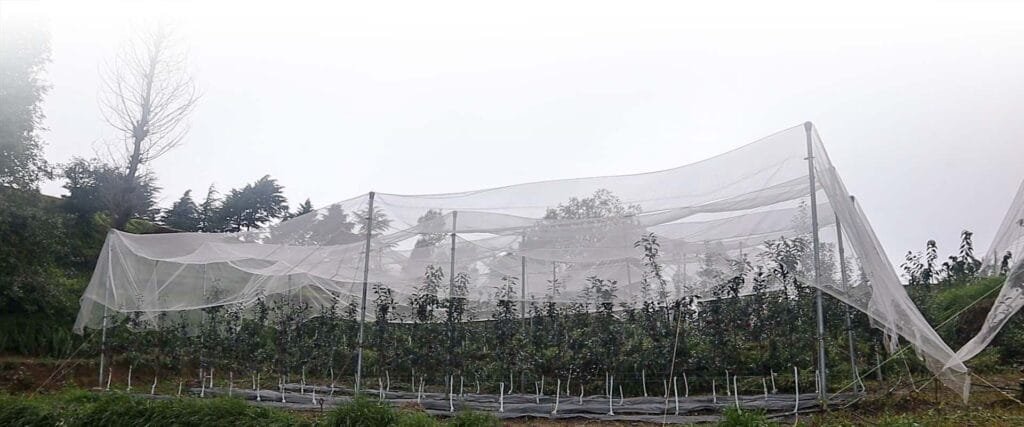
- Anti-Hail Netting: ₹300 – ₹400
- Drip/Fertigation: ₹200 – ₹300
Summary: You are essentially investing roughly ₹2,000 to ₹2,300 per tree to build a “world-class workstation” for your fruit.
B. The Annual “Salary” of Your Land
Unlike traditional farming where you wait 8 years, HDP starts paying you back in Year 2 or 3.
| Year | Yield per Tree | Total Yield (1,000 Trees) | Revenue (at ₹80/kg) |
| Year 2 | 2 kg | 2,000 kg | ₹1,76,000 |
| Year 3 | 5 kg | 5,000 kg | ₹4,40,000 |
| Year 4 | 9 kg | 9,000 kg | ₹7,92,000 |
| Year 5 (Maturity) | 12–15 kg | ~14,000 kg | ₹11,20,000+ |
Note: These are conservative estimates. Premium varieties like Gala often fetch ₹100–120/kg in 2026 mandis.
C. The “Net Profit” Logic
After Year 5, your annual maintenance (manure, pruning, electricity, labor) is roughly ₹2 to ₹3 Lakhs per acre.
- Gross Income: ₹11.20 Lakhs
- Minus Expenses: ₹2.50 Lakhs
- Net Take-Home Profit: ₹8.70 Lakhs per year.
💰 Why this beats a Bank FD or Traditional Farming
If you put ₹20 Lakhs in a Fixed Deposit (FD) at 7%, you earn ₹1.4 Lakhs a year.
With Orchard Solutions HDP, your land generates ₹8.7 Lakhs a year after maturity—nearly 6x higher returns.
The Break-Even Point: > By the end of Year 5, you have usually recovered your entire ₹20 Lakh initial investment. From Year 6 to Year 25, the orchard is a “profit machine” providing steady wealth.
Key Factors that “Protect” Your Math:
- Anti-Hail Nets: These ensure a single 15-minute hailstorm doesn’t wipe out your ₹11 Lakh revenue.
- A-Grade Consistency: In traditional orchards, only 40% of fruit is “Grade A.” In our HDP systems, over 85% of fruit is “Grade A” (premium size and color), which is why you can demand higher prices.
4. The Anatomy of a Modern Orchard
Fruit farming is no longer just “planting a tree.” It is an engineering project. Orchard Solutions focuses on three critical pillars:
A. Elite Genetics
We provide certified Feather Plants (3+ to 7+ branches). Unlike a thin stick (whip), a feather plant comes with a pre-developed canopy architecture, allowing for immediate fruiting potential.
Key Varieties for 2026:
Kingrot
Mema Mester-2284
Gala Star
Jeromine and Etc.
B. The Trellis & Netting “Exoskeleton”
High-density trees are prolific but physically delicate. They cannot support the weight of their own fruit.
- Trellis: We use high-tensile galvanized wire systems to act as a “spine” for the trees.
- Anti-Hail Nets: Climate change has made hailstorms more frequent. Our UV-stabilized netting protects 100% of your crop from mechanical damage.
C. Precision Fertigation
Every drop of water counts. Our systems deliver a precise mix of water and nutrients directly to the root zone via drip lines. This reduces water waste by 50% and ensures the tree is never stressed, leading to better fruit “crunch.”
5. Strategic Planning: Small vs. Large Scale
- Small Scale (0.25 – 0.5 Acre): Ideal for high-value “Boutique Orchards.” Focus on 100% “Extra Class” fruit for direct-to-consumer sales or high-end gift packaging.
- Commercial Scale (2+ Acres): Focus on volume and mechanization. Large-scale orchards benefit from bulk procurement of inputs and better bargaining power with big retail chains.
Conclusion: Is Your Land Working for You?
Land is a finite resource. If your current crops are only yielding marginal profits, it’s time to look at the vertical potential of fruit farming. At Orchard Solutions, we don’t just provide plants; we provide a blueprint for a profitable future.
Would you like a customized ROI calculation based on your specific land size and soil type? Contact us for a consultation today!